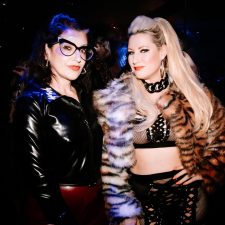









BEV, aka music journo ‘Betty Page’, shows off her EctoMorph latex alongside the Skin Two show’s strongman – at the Embassy Club, July 1985 (photo: Andy Phillips)
Skin Two memories: from clubber to co-host – by Krystina Kitsis
DECEMBER COVER STORY: In this companion piece to Krystina’s EctoMorph at 40 memoir – our September cover story – she returns to the 1980s for a more detailed focus on her involvement in the early London fetish scene. From discovering the original Skin Two Club in 1983, she progressed to partnering in 1985 with Skin Two magazine’s Tim Woodward to relaunch Skin Two club nights at the Embassy, where she also launched EctoMorph. Banner model Sue Scadding and principal photography from the Embassy: Andy Phillips
My model pal Sue Scadding (seen in the banner above), my then partner William and I were excited at the prospect of a new club called Skin Two being launched by Daniel James (whom we knew as Bill at that time) and David Claridge at the end of January 1983.
Bill and David were both friends of Sue and had arranged for her to have a photo shoot with fashion and music photographer Peter Ashworth for a forthcoming single that Sue was expecting to release imminently.
But the single’s release was delayed (it was not actually released until years later) so the image (in B&W) was used instead to promote the launch of the Skin Two event, and the original colour version became the front cover of an issue of AtomAge International magazine.

ASHWORTH’S 1982 shoot with Sue Scadding was used (in B&W) to promote the Skin Two Club’s launch in January 1983, while the colour original was used for this AtomAge International cover
Sue, William and I were seasoned clubgoers. having gone through reggae, northern soul, disco and punk nights — anything as long as we could dance.
As lovers of night life we had followed Bill through his various club incarnations, and this next launch, we envisioned, was going to be spectacular.
At that point I knew about fetish clubs only from doing postgrad research into fetish-related material, and from seeing gay men wearing rubber at clubs like Heaven, or punks in fetishwear on the streets.
For punks, fetish gear was worn to cause people shock and offence. But seeing people who wore latex because they liked it and felt good wearing it was going to be a different experience.
Maybe a shock element was there for the latter group too. But it was not intended to offend; rather to have the opposite effect of seduction and allure. A positive rather than negative experience, not confrontational but back to its original intention as sex clothing.
I was at the time doing a research degree on the connection between sexuality and fashion at the Royal College of Art, and I was particularly interested in subcultures.
For me, subcultures were originators of a particular style that defined their tribe, and clothing was one of the social indicators of their difference from mainstream society.
Their styles did of course eventually filter into mainstream culture, especially after being picked up by the fashion industry, which would diffuse the original meaning as expressed by the subculture and turn the ‘look’ into a fashion trend.
Plus, the look was adopted by followers who may not have been proponents of the original tribe, but came onboard by sympathising with the sentiments expressed, or decided to use the look to express something else in themselves.
My research looked at the way fetish was represented in the high class worlds of fashion photographers Helmut Newton and David Bailey.

HELMUT NEWTON’s use of fetish-erotica in his fashion photography, as featured in White Women (1976), was the polar opposite of the domestic snaps found in the pages of AtomAge
Both men used the edgy, seductive themes of fetish on beautiful women, dabbling with themes of master and slave to compose iconic images that were ultimately used to sell an idea and a product.
I also came across more underground images of ‘real’ people in the pages of AtomAge, which featured subjects who were not professional models, posing in domestic settings. These images were more outrageous and bizarre to the untrained eye.
I wasn’t a participant at that stage. But the original Skin Two Club opened my eyes to a whole, previously unknown world that would change the course of my life forever.

LESLIE, David Claridge’s partner, channelling Bulle Ogier’s character from Maitresse while on Skin Two reception duties at Stallions in 1983 (photo: Derek Ridgers)
Descending the stairs down to gay club Stallions in Falconberg Court where Skin Two was being launched — after walking past the dingy, prostitute-laden doorways in the back streets of Soho — was like stepping into the pages of AtomAge.
The characters I had encountered while leafing through that magazine were there for real. I had my camera with me. I had been photographing people for years in clubs as a way of documenting the events, but the photos were never published.
I was astounded to see the diverse collection of people in catsuits, leather bodies, chaps, stilettos, fetish underwear… a phantasmagorical collection of fetish gear and all in black.
There were gays, straights, bisexuals and pro dommes; there were ordinary people dressed in fetish gear chatting to each other, dancing, or posing in the arches, at the bar or in the corridor by the cigarette machine.
The age range was vast and everyone was so friendly. It was not a threatening environment at all, even though many were masked and black was de rigueur — or basically, black was what most people wore as it signified outsider status, the colour palette of rubber sheeting being very limited at that time.
This was a very different subculture from those I had encountered while growing up, which had been defined by youth. Skinheads were my tribe in my schooldays.
In north west London where I lived and went to school, they were the dominant youth cult, embraced by me for fear of being beaten up by the skinhead girls I was at school with.
I loved the music — reggae and dub — and liked the look of the button-down pleated check shirts and Harrington jackets etc. But I didn’t agree with their antics and aggressive behaviour.
I then moved on to becoming a hippy at my sixth form college in Harrow and on my foundation course. There, I substituted velvet and flowery, long-flowing dresses for my earlier two-tone suits and bovver boots, and long-flowing tresses for my old shorn hair.

BOY GEORGE was among Krystina’s peer group from The Blitz and Central St Martins who became famous and in some cases also lifelong friends of hers (photo, 1981: Derek Ridgers)
Then, once enrolled at Central Saint Martins, I became a voyeur of punk. I never liked punks at the time but was fascinated by their choice of dress and do-it-yourself attitude, and their slashing of clothing.
Then came the New Romantics. It was here where I felt really at home, as I was one of the creative people who made up the group. We were all at art school and would express ourselves at night by going to clubs like The Blitz.
Some would become lifelong friends. I took lots of photographs of my peer group, many of whom — like Sade and Corinne Day, John Galliano, Chris Sullivan, Boy George, Spandau Ballet, Gilbert and George, Duggie Fields and Andrew Logan (to name but a few) — became famous.
The Skin Two scene was different. Its clientèle was not defined by youth or working class British culture, and was unlike a lot of subcultures that had evolved from people associated with an art or creative background.
People there from all ages and backgrounds were united by their shared interest in kinky clothing. Most people, I discovered, purchased their clothes from such early fetish suppliers as Sealwear, She An Me or Weathervane.
READ MORE – GO TO PAGE 2 OF 2BELOW: Galleries showing EctoMorph’s debut fashion show at the Embassy (photos: Andy Phillips)
Click/tap either preview to open its gallery and click/tap any gallery thumbnail to start slideshow
Tags: Community, Fetish Parties, Latex
 Share On Facebook
 Tweet It