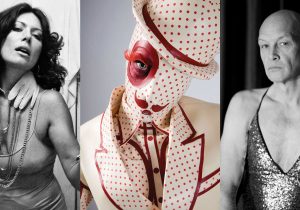








B+W CLASSIC: Girlfriend/muse Yee in Fräulein Ehrhardt latex, LA 2011 (pic: Steve Diet Goedde)
Steve Diet Goedde marks 25 years with Arrangements III.
Steve Diet Goedde has just published the first book in his much-awaited 25-year retrospective trilogy. Arrangements Volume III covers his most recent work from 2007 to the present. Tony Mitchell reviews the book and talks to Steve about his passion for low-fi cameras, the ‘photographer and model-girlfriend’ syndrome, why getting his work into print with a reputable publisher is still really important to him, and lots more. Steve shot our banner image of Stoya wearing Syren Latex in LA in 2014
Goedde (pronounced Geddy) planned for the three-volume retrospective — to be edited by Eric Kroll (another West Coast photo legend) and published in collaboration with Los Angeles fine art gallery Century Guild — to be published in reverse order.
Arrangements Volume III, covering the years 2007-2015, was slated to appear first, in the summer of this year. And it has arrived bang on schedule.
The standard hardcover version of the book (there are also two clamshell editions) immediately evokes The Beauty of Fetish and The Beauty of Fetish Volume II, Goedde’s highly collectable monographs from Edition Stemmle published in 1998 and 2001 respectively.
The large 248 x 311mm (9.75 x 12.25in) page dimensions, the expensive art paper, the heavy board covers and the cloth binding send out an unequivocal message of serious intent, of artistic quality to be savoured and cherished.
And the 148 pages of black-and-white and colour images between the covers easily live up to that promise.
The only immediately obvious departure from the presentational style of the Stemmle books is in the cover image of the new book.
Rather than the shiny latex-clad models fronting the Swiss publisher’s offerings, the cover of Arrangements Volume III reflects Steve Diet Goedde’s increasing interest in low-fi photography during the years represented by this book.
The cover’s grainy and tonally muted close-up of a corseted torso, nylon-clad legs and high heels reflected in glass is revealed inside to be a photograph of Eden Berlin taken in Germany in 2007, at the start of the period covered by the book, when Eden was still very new on the scene.
But while you’ll find many more images of this type, featuring ‘softer’ fetish looks (lingerie, hosiery, heels, vintage frocks), those who admire Steve’s distinctive way of capturing latex will not be disappointed. Fans of the era’s best-known models should be happy too.
The mainly (but not exclusively) US-based selection found here also includes Masuimi Max, Angela Ryan, Jade Vixen, Skin Diamond, Ulorin Vex, Mosh, Kumi, Stoya, Ancilla Tilia, Nola Berlin and Caroline Aquino, to name just a few.
‘The word “languid” comes to mind… Moments glued together by Steve’s demanding standards… creating a world that is fashion, not photo- journalism’ – Eric Kroll, editor
As Steve Diet Goedde and I go back a long way (I published his first ever magazine portfolio in Skin Two Issue 15 in 1994), I was delighted when he agreed to be interviewed about his new book for our August cover story.
I began by asking him what it felt like finally to have the finished product in his hands some 18 months after it was first announced.
SDG: It’s an incredible thrill holding this book as a physical object. For over a year it has existed only as a collection of digital files. It’s a relief knowing that it turned out so well.
When the Kickstarter campaign was in gear, I was constantly nervous about whether it would get funded or not. Once that hurdle was achieved, I was nervous about the quality — I didn’t want to disappoint all those people, especially the high-dollar pledgers who put a lot of money into this project. So yeah, a big sigh of relief from me! I couldn’t be happier.
TM: Do you feel that everything you hoped for in terms of ‘product quality’ meets with your satisfaction?
SDG: Yes, I’m extremely happy with the publication. There might be a few images that I’d tweak a little bit to adjust contrast, but those are things only I would notice.
TM: Have any lessons been learnt from production of the first volume that you plan to apply to the following two books (due out over the next couple of years)?
SDG: Mostly a better workflow situation on my part. The next book will have a much faster turnaround time. For this volume, I had so many different source files — scans from negatives, original digital files, scans of Polaroids, iPhone shots, Polaroid transfers, etc.
I had to go back and redo a lot of the files to correct colour profiles, etc. The next books will mostly be negative scans and simple digital files so it won’t be as complex.
TM: The choice of the book’s covr image and design style says to me that inside, I’ll find the work of a serious artist — not just a collection of shiny fetish-glamour images. Also, that you’re not afraid to wear your low‐fi heart on your sleeve.
‘I’ve always been aware of book covers and how they compare to what’s inside the book… The cover should be a tease and only hint at what delights are inside’ – Steve Diet Goedde
SDG: I’ve always been aware of book covers and how they compare to what’s inside the book. A first instinct, especially for a book of ‘shiny fetish-glamour images’, would be to put the most sensationally sexy photo on the cover to attract buyers.
Instead, the cover should be a tease and only hint at what delights are inside. Once you’re intrigued by the cover and open the pages, you’re presented with a treasure trove of visual delights that surpass the cover photo. You shouldn’t give it all away at first glance.
TM: Jumping from the front to the back end, I was really interested to read your postscript, in which you talk very honestly about the effects of time on the ability of artists, yourself included, to replicate the driving energy of their youth. And what your approach was to counteracting this seemingly inevitable syndrome.
I remember when I first encountered your move into low‐fi photography — it was when you started shooting Polaroids as finished work, and then started experimenting with early iPhones. To be honest, I wasn’t sure at first what was motivating you. But now I’m happy to say it all makes much more sense!
Did it confuse others at first too? Can you remember what kind of reactions you got from other people — from your artistic peers, and from your fans and critics — when you embarked on this new direction?
Did you ever doubt that it was the right direction for you to be taking, after establishing such a great reputation as a fine art photographer with a recognisably fine art style?
SDG: I don’t think I’ve ever received any negative feedback about my exploration into low-fi photography. When I did my first iPhone erotica shots in 2008, the response was overwhelmingly positive.
I even produced a limited series of small prints from my first iPhone session with Naturale which sold out quickly. That positive response further fuelled my interest in pursuing the style.
Besides loving the look of the photographs, I somewhat did it as a statement that the quality of a photograph cannot be measured by the quality of the camera. Give me a (then) shitty iPhone 3 camera, and I can still make a powerful photograph.
I was just proving the adage that it’s not a camera that takes a good photograph, it’s the photographer — the one who has the vision no matter what the tool. Plus, discovering this new method helped me at a time when I was feeling creatively stagnant.
QUICK LINK: stevedietgoedde.com
READ MORE – GO TO PAGE 2 OF 2Click on any thumbnail below to open our Steve Diet Goedde: Arrangements Volume III gallery
Tags: Book Releases, Latex, Lingerie, Models
 Share On Facebook
 Tweet It