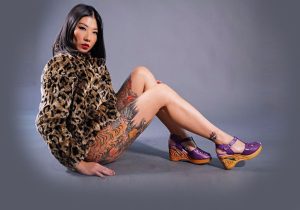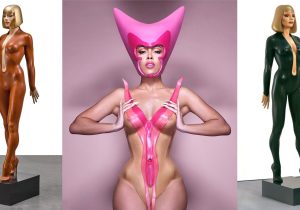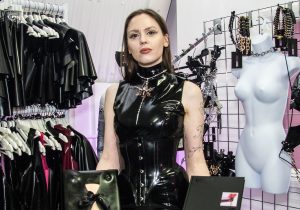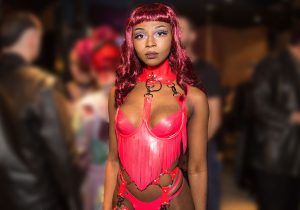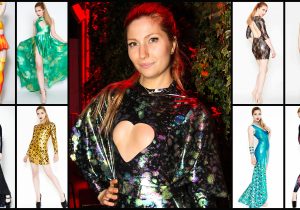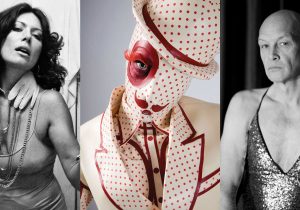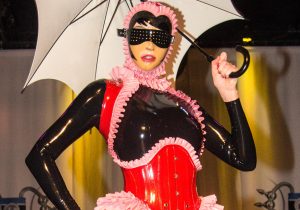






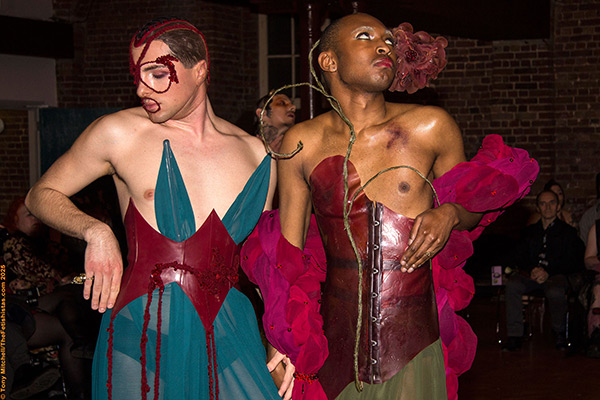
METAMORPHOSIS performers @m_our_y (left) and @domjoshuamurray (photo: Tony Mitchell)
“The idea is not just for me to get the credit for this,” Iris explains, “but for the people who are part of it to get more job opportunities, more collaborations, to be hired by maybe bigger brands if someone likes the work.
“So this is a good outlet — it’s almost like they’re doing an exhibition. You exhibit your items but you don’t expect to be paid for the exhibition. And it’s the same here. So this is a showcase for them to use as an exhibition.
“Clothes, shoes and jewellery don’t always go to an exhibition, or they go at a later stage. But we all need a showcase to show people.”
The Metamorphosis performance had a choreographer and people working on the set design, “so it felt more like an art performance than just a catwalk where people would observe every garment for, like, five seconds while it’s running in front of them”.
Presenting the work this way, Iris says, gives the audience the space and time to “observe and admire what we’ve worked on”. They will see that the people who work on it are “part of the group, not people who will just do wholesale pieces”.
“Because we don’t want to make the stuff look easy to make and cheap. We want the stuff to look super-bespoke and exclusive. That’s the feeling we want to give to the person who comes to see it.”
It seems evident to me that Iris and her collaborators are striving for a sense of authenticity that they find lacking in a lot of modern ‘creative’ endeavour.
“People still love fast fashion and people still buy stuff from platforms like Shein,” she says. “And I feel that with AI creating art now, you can see pretty things everywhere on the socials.
“But I think what people are missing is to go somewhere and see the real thing that they can experience not just visually, but to see the real act and feel the energy of it.”
AI can’t take over ‘the art part of things’
But while she’s conscious of the debate around AI “taking over the art part of things”, she doesn’t believe it can really do so.
“Because art is about the energy, and the feeling that someone has actually made it with their hands.
“There’s no real beauty in looking at something that was just digitally made. It’s beautiful to look at but you just look at it, you don’t feel the energy of it until it’s in front of you.”
Apart from wanting to emphasise art made in the corporeal rather than digital world, the Fade in Decay team sought with Metamorphosis to address the issue of toxic masculinity.
“We were focused on the way there’s basically a systemic pressure on men to behave in a certain way, which detaches them from any emotional expression or self-expression, and to a good extent casts them off from any sort of creativity.
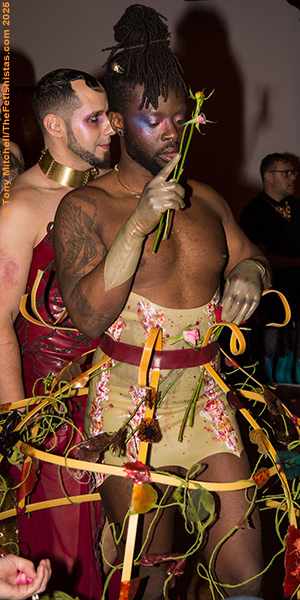
METAMORPHOSIS performer @missterriboxx
“We wanted to create an image for masculine figures and people who were born in a male body — no matter how they express themselves today — to be seen in beautiful gowns, beautiful dresses, with beautiful make-up on, beautiful jewellery, really nicely-done hair, and almost dance — perform and dance — on stage.
“If you noticed, at the actual show they start out being distanced from each other and they slowly come closer, start observing each other, touching each other, copying each other’s movements, identifying with each other’s beauty.
“And at the end they’re given roses. Men are not really given flowers. It’s almost as if people don’t consider that a man would be expecting to receive flowers or something soft and gentle and beautiful.
“If you noticed, the person who had the flowers in the show had a more colourful outfit than the rest of the people.
“And they gave the flowers to everybody else. And you saw how the models started taking the petals apart and throwing them behind them, leaving a nice trail of colourful petals, which was really beautiful.
“We tried to make the best outfits we could to attain the level a normal couture fashion show for women would be seen at, but this time giving the opportunity to masculine figures to be fitted in them.
“And I was actually really surprised and impressed, as I didn’t expect all the models to fit so beautifully into their onstage characters.
“I thought they would be good but I wasn’t expecting to see so much expressiveness. Which means also that whatever we were
putting together worked, because the people there felt it and transmitted this feeling to the crowd.”
Returning to the matter of the no-shows by fashion industry colleagues Iris had invited to the launch, she seems disappointed by this, although, she insists, not disheartened.
“I just understand that they’re not my people,” she says. “Being a fetish-wear brand and having lots of fashion people come and get my things pretty often, I thought, OK I’m also part of the fashion scene.
Little space for art in the fashion scene
“But actually I’m not. It’s not a matter of respect because they do respect my work; if they didn’t respect it they wouldn’t want to use it. But I don’t feel that there’s as much art, or much space for art, in the fashion scene.
“I think the fashion scene is more focused on identifying as something other than what you are — it’s almost like masking. While what I’m doing is expressing people’s authenticity.
“In the fetish scene people do have a character, they adopt a character. What I’ve learnt from the fetish industry on this is to be my own person, because I don’t feel restricted to do something else.
“But I feel that labels exist everywhere, and the idea for me is to erase any labels in general.
“The idea is to be able to transform the way you feel right now, without having to be this style or this vibe or this energy because there’s an expectation that people will see you and read you in a certain way.”
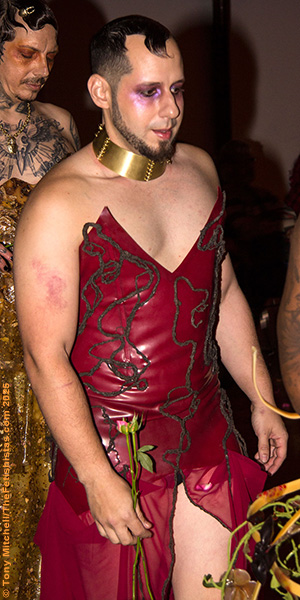
METAMORPHOSIS model @sununu_hernandez
She mentions having seen Vivienne Westwood in videos “talking about working on your own clothes, wearing stuff that you like, and being yourself”.
“I identify with this quite a bit — I think that’s really important if you want to be authentic, and if you want to feel free and if you want to create.
“You can’t do it if you’re not yourself and if you have to go under a certain label. Which is also why I don’t want this project to fall under ‘fashion brand’ or ‘fetish brand’. It is an art project, and art can be anything.”
What it’s like working with ‘big fashion’
On relationships between fetish and fashion, I recall House of Harlot under Robin Archer being the first latex specialist to produce garments for a high fashion brand, creating a tradition that has continued under Iris.
So I ask Ms Trika if she could give us some inside track on what it’s like working with those big fashion brands. After all, many latex designers would probably give their eye teeth for a bite of that particular cherry.
And it would be great to have her views on what some latex fans, seeing celebs in high fashion latex on red carpets etc, might well consider an appropriation of fetish culture for extremely superficial purposes.
“I think each brand is different to work with,” comes the reply. “It’s like a different family system in each brand. I can say that when the project is couture, they definitely respect you way more, because they respect your art, because they do art.
“If they want it for fashion — something they’re going to put in retail shops — you’re just a ‘factory’ ’cos you’re only doing production for them.”
Iris then reveals that some time ago she felt seriously demeaned by someone she’d been working with for years calling her just that: a ‘factory’.
“I found it really disrespectful at the time, but it also made me think. I know that in the latex industry I’m one of the best qualities and have a brand with one of the longest histories in the industry.
“I don’t mean that other people that came later don’t do great stuff, but I carry a certain heritage. And I had this person whom I worked with for about five years in a row on his collections — a smaller designer, independent, who came from a bigger brand which I cannot name.”
On the last of these collaborations, Iris explains, lots of things seemed to be going wrong. She felt the problems were being caused by the designer, and being the fearless soul she is, she told him so.
“And he said something along the lines of ‘At the end of the day you’re just a factory’. And I said: ‘I’m not a factory, I’m one of the oldest latex brands. I’m a designer — maybe not a designer in your field but I’m one of the top designers in my industry.
“I said ‘You wouldn’t go to Dior and tell them they’re a factory.’ And he said ‘But you’re not Dior because Dior doesn’t do production for other people’.
READ MORE – GO TO PAGE 3 OF 3Fade in Decay Metamorphosis debut performance: 30 pix
Click/tap either preview to open gallery, then click/tap a thumbnail to start slideshow
 Share On Facebook
 Tweet It