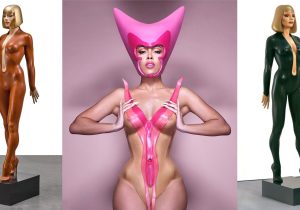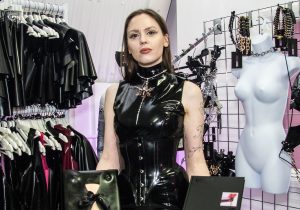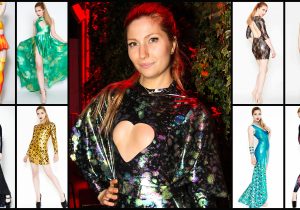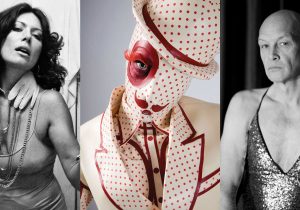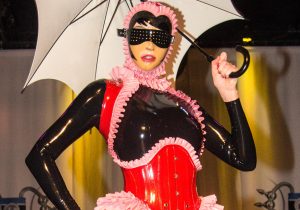







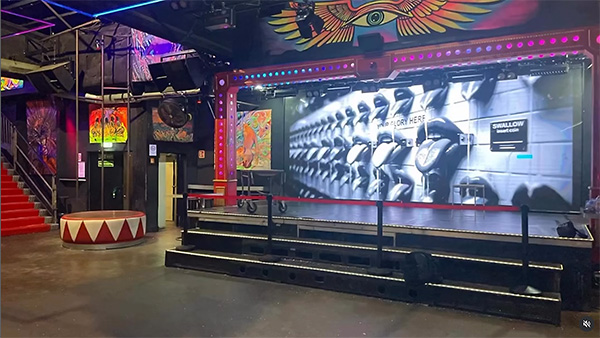
LEILA’S VIDEO installation at the Wasteland party at KitKatKlub Berlin this May. Below, Watch all five videos shown there, and learn about her process of creating them (photo: @wilhelmusvlug)
Wasteland commission prompts Leila’s move to video
This section features Leila Lovit’s account of how she rapidly progressed to making professional AI video, and it includes the first five professional AI videos she made — at Wasteland’s request. You can watch them in-page at normal text area width, or click the arrows (bottom right) to expand them and view at full screen width…
Like many other AI creators, Leila Lovit began her journey with AI creating single images, followed by the odd experiment with phone video.
But when her work came to the attention of Dutch mega-fetish party brand Wasteland, the organisation approached her for some original fetish video to promote its November 2025 Masked Ball at the Northsea Venue near Amsterdam.
Lovit’s response to being offered her first ever AI video commission? “I immediately told
them I would only work in black and white. I’ve made a few colour videos since then,” she adds. “They’re great, but far less striking.”
But while Wasteland was the reason she started making AI video, she wasn’t quite ready to do it for the party’s November 2025 edition. Instead, she confesses, “Because I always pretend to be braver than I am, I made them a super‑fast slideshow.
“After that, I really started learning how to make proper video. I create the scenes with AI, but all the editing and effects are done with regular software. I learned in a few months what would normally take years.”
Upskilling herself so quickly enabled Lovit to create five short videos in time for them to be premiered at Wasteland’s Special Edition party at Amaze Amsterdam in April this year.
The five were then showcased again at Wasteland’s KitKat party in Berlin this May — and she has now provided them for inclusion in this article too.
“I chose those five videos because they were my first professional pieces. Before that, everything I made was quick experiments on my phone — spontaneous, playful, but not intentional.
“These Wasteland April videos were the first time I sat down and said: ‘I’m going to make a real video installation’.
“I wrote the concepts, created all the images and clips myself, and then taught myself editing and adding effects from scratch. I had never worked with video professionally before, so every step was new.
“And yet the final result felt so right. These were the first works where I sat back and thought: I can’t believe I made this… and they’re actually good.
“That was a turning point for me. It was the moment I realised: I’m not just experimenting any more — I’m genuinely good at this. Everything clicked: the AI, the editing, the atmosphere, the tension, the surrealism.
“That’s why these five videos are my favourites. They’re not just strong pieces; they’re the moment my confidence arrived!”
Separating out the three types of fetish AI creator
I tell Leila that, in my line of work, I’m accustomed to seeing AI imagery from photographers who’ve progressed to it via digitally enhancing their photographs, and from artists who have come to it primarily via an art/illustration background.
But, she argues, I’ve neglected to mention the third — and by far the largest — group.
“For the first group — photographers who moved into AI after years of photo manipulation — AI feels like a natural extension of the tools they already used — a way to push their photography further,” she offers.
BELOW: More Leila in leather (image: Leila Lovit)
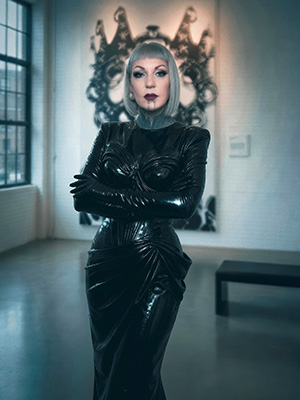
“The second group — artists who already worked digitally and saw AI as an expansion of their visual language — is where I belong.
“My background has always been digital art — so AI became the perfect medium to merge those worlds. I don’t enhance photos; I construct characters and atmospheres entirely from scratch.”
The third group, she reckons, is the one responsible for most of what people call ‘AI slop’.
“These are creators who don’t come from photography or art, and who use AI without a visual foundation or artistic intention. The results often look technically impressive but aesthetically empty.
“I find that kind of work very difficult to connect with, because it lacks the visual history, discipline and emotional intention that make imagery meaningful.
“That’s why the split between them is interesting: the first two groups create distinct, intentional work because they bring a visual past with them. The third group produces volume, not vision.
“My own transition into AI wasn’t a step up from photography; it was the continuation of a long visual journey.
“AI simply gave me the freedom to build the worlds I had been trying to create all along.”
Why Leila considers ‘adult’ AI art ‘flat and predictable’
If we’re looking for an explanation for the prevalence of work by other AI creators that “leans into the flat, generic adult‑ content aesthetic”, Lovit can provide one.
“With AI, you can create the most generic explicit imagery imaginable. Because there are so few platforms that allow NSFW content, the visual culture on those platforms becomes very narrow.
“They’re usually not designed for artistic work — they’re built for fast, credit‑driven consumption. And because of that, most of the AI work produced there ends up looking cheap or artificially generated.
“There are exceptions, of course, but the overall aesthetic still feels flat and predictable because the ecosystem doesn’t support nuance, atmosphere or experimentation.
“So the ‘cheapness’ isn’t caused by the subject matter — it’s caused by the environment. When a platform rewards speed and volume over artistic intention, even good ideas end up looking generic.
“Many people also burn out quickly,” she observes. “Their inspiration runs out, or maybe there wasn’t much to begin with. And then there’s that huge pile of AI ‘slop’
that I honestly feel embarrassed to be associated with.
“When I tell people I make fetish visuals, that’s often the first thing they think of. I always ask them to look at my website or Instagram first.
Is there someone she knows of whose mind was drastically changed by following her advice and looking at her work first?
“Yes — one of the clearest examples was someone who became a huge fan of my work. She left beautiful comments, shared my posts, and told me how much she loved the atmosphere and the aesthetic.
“But on her own profile she was loudly posting about how much she hated AI. I pointed out that it was a bit hypocritical to praise my work while condemning the medium, and we actually had a good conversation about it.
“In the end she admitted that my visuals didn’t fit her idea of ‘AI art’ at all, and that she had judged the whole field based on the cheap, generic slop she kept seeing online.
“She told me my work changed her mind about what AI can look like. She is still my super fan!”
Finding unexpected fans among fetish photographers
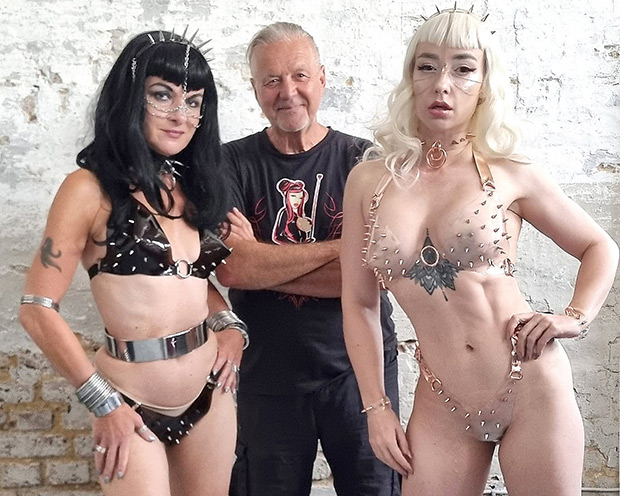
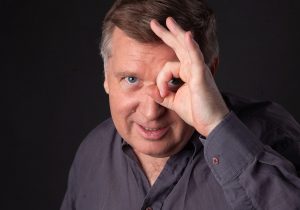
PETER CZERNICH, photographer and Marquis founder – seen here with models J Delicious, left, and Lotte LaVey (yes, it’s her again) – told Leila her work was ‘the best AI art’ he’d seen online
Leila says she has been surprised most by how many fetish photographers have also become fans of her work.
“Considering the fear that AI ‘steals’ from photographers, I expected resistance — but instead I’ve received a lot of respect.
“One of the biggest compliments I’ve ever received came from [photographer and Marquis founder] Peter Czernich, who told me my work was the best AI art he’d seen online. I’m still proud of that.”
Furthermore, Leila has just learned that she has been nominated for Artist of the Year in the Marquis 2026 Awards.
“It feels like everything is happening at once right now,” she says. “Intense but exciting, and truly a great recognition.”
However, she’s also fully aware that some people in the scene still prefer a strictly traditional approach, that is sometimes expressed as only liking ‘real women’ in latex.
“That aesthetic has a long history, especially within publications like Marquis,” she acknowledges, “so it makes sense that some people might want to preserve it.
“At the same time, I’ve noticed that many fetish photographers — including people whose work I’ve admired for years — have responded surprisingly positively to my visuals.
“Alex Perez is a good example. We’re longtime friends and I’ve always respected his photography, so having him genuinely appreciate what I’m creating feels meaningful.
“Maybe that’s why the recognition hits so deeply. I’m a complete autodidact — I never went to an art academy; I had to teach myself everything.
“So when people who’ve been part of this world for decades respond with openness instead of resistance, it shows me that you don’t need a traditional background to create something that resonates.
“And honestly, I think a lot of traditionalists soften their stance once they actually see the work. They realise it’s not trying to replace photography — it’s exploring a parallel visual world with its own logic, atmosphere and artistic intention.
“That’s what encourages me most: AI and traditional photography don’t have to be in conflict. They can coexist, and sometimes even inspire each other.”
BELOW: Final two of four galleries showcasing a total of 35 large Fine Art AI images by Leila Lovit.
CLICK/TAP either preview to open its gallery, then click/tap any thumbnail to start slideshow
 Share On Facebook
 Tweet It