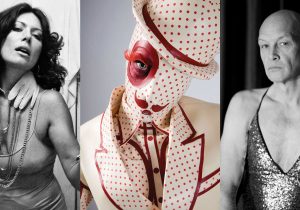






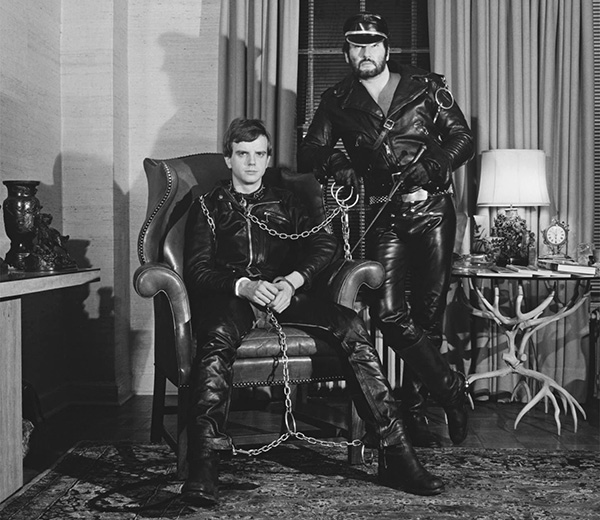
LEATHERMEN in a famous image by Robert Mapplethorpe, who inspired Leila with his unmatched ability ‘to make fetish elements feel both iconic and intimate’ (photo: robertmapplethorpe.org)
Some photographers who’ve inspired Leila Lovit
I ask Leila to namecheck some of the photographers — fetish or otherwise — she admires.
“There are several photographers whose work has inspired me, especially those who embrace a raw, fine‑art aesthetic, she replies.
“Helmut Newton is my strongest influence. His high‑contrast compositions, sculptural bodies and that elegant sense of danger resonate deeply with the atmosphere I try to create. My images give me the same feeling: beauty with an edge, glamour with tension.
“I also draw inspiration from Robert Mapplethorpe — his ability to make fetish elements feel both iconic and intimate is unmatched.
“Anton Corbijn’s stark, emotional black‑and‑white work shaped my love for minimalism and mood. Erwin Olaf’s theatrical, surreal compositions taught me a lot about atmosphere and storytelling.
“Rick Castro’s work has also been important to me — the unapologetic queer underground energy, the documentary rawness, the way he captures fetish culture without polishing it. There’s a vulnerability and defiance in his images that I deeply admire.
“Beyond them, I admire artists like Guy Bourdin, Ellen von Unwerth, Daido Moriyama and Irving Penn’s more textural work. They all share that commitment to atmosphere, grain, imperfection and emotional charge — the kind of imagery that feels alive rather than polished.”
Digital timeline and evolution of a distinct visual style
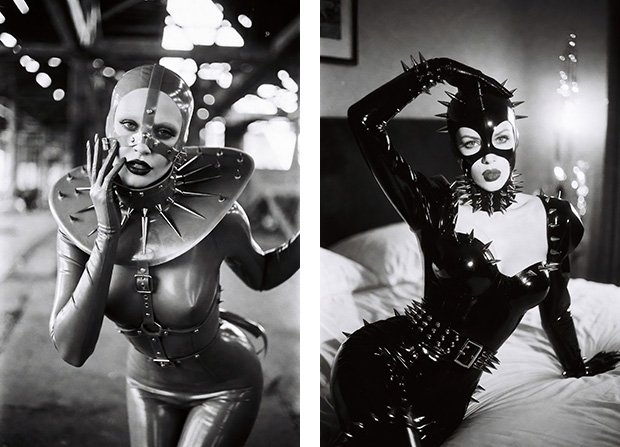
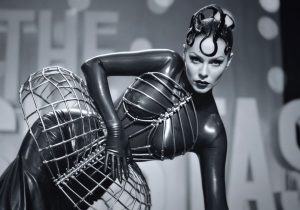
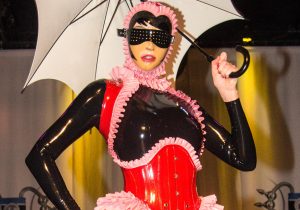
CLASSIC BEAUTIES 6 & 7 from Leila Lovit’s Fine Art series (images: Leila Lovit)
Leila is keen to emphasise that her own visuals are not based on or built from the work of any of the influential photographers she cites above — or any others.
“I generate my models entirely from scratch — but I recognise a shared artistic spirit,” she explains.
Before Leila Lovit started using AI, she was already doing digital art and photo manipulation. “And even then I tried to push my images into that rougher, more visceral direction,” she reveals.
“My older work was more glamorous; my newer work is much harsher. I love both sides — and also the humorous videos I sometimes make. It really depends on how I feel in the moment.”
Her timeline with digital art goes back much further than AI, she explains.
“I started in 1999 — literally on the day I bought my first Mac. A friend who taught DTP gave me a lesson book, and that was the beginning of everything.
“From there I moved into photography, mostly analogue and always in black and white. I loved the rawness of film: the grain, the imperfection, the visceral texture.”
She found that, when digital cameras became the norm, she couldn’t recreate that same feeling, so she began manipulating her photos to bring back the atmosphere she missed.
“My photography has always been architectural — strict lines, strange angles, compositions that feel almost sculptural. I’m actually planning a trip through former Soviet countries also to photograph decaying Soviet modernism, because that aesthetic speaks to me deeply.”
At the same time, Leila adds, her love for fetish fashion has always been very real. “Latex, sculptural silhouettes, the tension
and elegance of fetish imagery — that’s a world I’ve been drawn to for decades.
“The simple truth is that I’m not a strong people photographer, at least not in the traditional sense. I’ve always been more comfortable with structures than with photographing human subjects.
“So I needed a medium that allowed me to explore fetish aesthetics without relying on shooting real models.
“When AI tools appeared, they became the perfect bridge between those two parts of me. My earliest AI work was more glamorous simply because the generators were still very limited two years ago.
“You couldn’t combine multiple aesthetics in one image, so the results leaned toward a cleaner, more polished look.
“In a way, the early limitations of AI shaped my initial style — I became known for something that was actually a technical constraint at the time.”
As the tools evolved, Leila’s work evolved with them.
“The moment I could push the visuals into a harsher, grainier, more visceral direction, I did. That shift wasn’t forced; it was simply where my artistic instincts had always been.”
So the steps in her creative process were, she considers, very organic: analogue black‑and‑white → digital photography → photo manipulation → architectural composition → early glamorous AI → and finally the harsher, more atmospheric signature for which she’s known now.
“AI didn’t replace anything for me,” she contends. “It gave me the freedom to merge my architectural eye with my deep love for fetish fashion. Over time, that journey helped me develop a very distinct visual energy: a signature that doesn’t imitate anyone, but stands entirely on its own.”
Comparisons with A Clockwork Orange and Sorayama
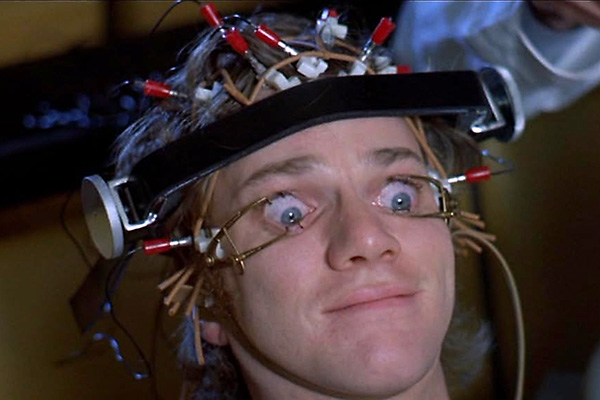
EYE SPREADER images by Leila Lovit are frequently compared to the aversion therapy undergone by Malcolm McDowell’s character, above, in A Clockwork Orange (1971; photo: imdb.com)
When people first encounter her imagery, Leila says, they often draw comparisons with the film A Clockwork Orange or the work of Japanese artist Hajime Sorayama.
If you’re familiar with the scenes in A Clockwork Orange where Malcolm McDowell’s character is forced to watch images of brutality as aversion therapy (see above), and you’ve also seen Leila’s eye-spreader videos and stills in this article or elsewhere… well you’ll understand why people might make that connection!
And yet, Leila herself confesses: “I only watched A Clockwork Orange after people kept mentioning it. I remember sitting there with my mouth open because the imagery felt like it had been pulled straight out of my own brain!”
She also admits to having to Google Sorayama when people first started comparing her work to his.
“That experience made something very clear to me: my visuals don’t come from those references — the references come to me afterwards.
“The facelessness, the discomfort, the mechanical tension, the surreal restraint… those elements were already part of my own inner world long before I knew they existed in pop culture.”
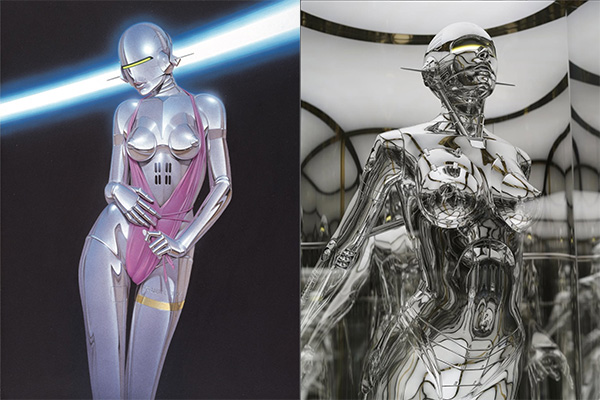
Sorayama’s influence, she says, shows up mostly in the materials — the glossy surfaces, the synthetic shine, the sculptural futurism.
“But the intention behind my work is very different. His world is polished and robotic; mine is faceless, uncomfortable, restrained and emotionally charged.”
And yes, she concedes, her eye-spreader pieces echo the aversion therapy scene from
A Clockwork Orange. But her version isn’t about suffering or control:
“It’s playful. It’s absurd. It’s almost dance‑like. I love taking something heavy in pop culture and turning it into something strangely elegant or even funny.
“That contrast — intensity with humour, fetish with lightness — is a big part of my visual identity. My work may look stylised or surreal, but the underlying impulses are very real. It’s fetish, but with a wink — and very much my own.
“It’s that sense of discomfort mixed with forgotten futures and a hint of glamour that creates something surreal.”
What exactly does she mean when she talks about ‘forgotten futures’?
“I mean the futures we once imagined — the ones that felt visionary at the time but now exist only as aesthetic memory.
“You see it in films like Metropolis: that strange mix of optimism and oppression, glamour and machinery, elegance and discomfort.
“My work often lives in that same emotional space. It’s not the future as we see it today, but the future as it was once dreamed. Glossy yet unsettling, mechanical yet human, surreal yet strangely nostalgic.
“That’s why ‘forgotten futures’ feels so right to me. It’s the atmosphere of a timeline that could have existed, but didn’t — and I like creating imagery that feels like artefacts from that lost possibility.
“And sometimes the figures I create simply need to be beautiful. Black and white is powerful for that — high contrast, minimal, direct.”
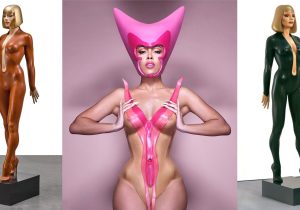
BELOW: Hajime Sorayama’s early Sexy Robot art, left; and right, a later sculptural recreation by Sorayama of the same character (photos: @hajimesoroyamaofficial)
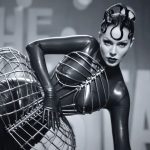
BELOW: First two of four galleries showcasing a total of 35 large Fine Art AI images by Leila Lovit.
CLICK/TAP either preview to open its gallery, then click/tap any thumbnail to start slideshow
 Share On Facebook
 Tweet It